
You are here
Feed aggregator
«Von ihm als CEO hätte ich etwas anderes erwartet»: Jetzt spricht der Mann, der von FDP-Michel beleidigt wurde
FDP-Nationalrat Simon Michel wurde wegen Ehrverletzung angezeigt. Der Ypsomed-Chef griff auf Linkedin einen Wirtschaftsprüfer an. Für den Betroffenen ist es unverständlich, dass dies unter die parlamentarische Immunität fallen soll.
Categories: Afrique, Swiss News
Alternatives au baptême: Le baptême est en chute libre en Suisse
Seuls 26,4% des nouveau-nés ont été baptisés en Suisse l’an dernier. À l’inverse, les cérémonies laïques ont le vent en poupe, pour le plus grand bonheur des grands-parents.
Categories: European Union, Swiss News
Mindestens 108 Opfer: Walliser Horror-Pfleger für sexuelle Übergriffe verurteilt
Ein rumänischer Krankenpfleger wurde im Wallis zu neun Jahren Haft und 15 Jahren Landesverweis verurteilt. Er wurde der sexuellen Nötigung und Vergewaltigung schuldig gesprochen. Die Taten ereigneten sich zwischen 2015 und 2023 im beruflichen und privaten Umfeld.
Categories: Afrique, Swiss News
Quartierplanung Prisma: Birsfelden BL soll Wohnturm von Herzog & de Meuron bekommen
In Birsfelden BL soll künftig ein weiterer Wohnturm stehen. Der 86 Meter hohe Bau des Architekturbüros Herzog & de Meuron ist Bestandteil der Quartierplanung Prisma. Die Gemeinde hat am Donnerstagabend das Mitwirkungsverfahren dazu eröffnet.
Categories: Afrique, Swiss News
Zelenszkij a méltányos béke és a garantált biztonság megteremtését hangsúlyozta
Volodimir Zelenszkij ukrán elnök reményét fejezte ki csütörtökön, hogy Ukrajna és az Egyesült Államok diplomáciai erőfeszítéseinek közös eredménye a méltányos béke és a garantált biztonság lesz, és ezek fő célja az Oroszország által Ukrajna ellen indított háború megállítása.
Categories: Afrique, Határon túli magyar portálok összesített hírei
Milliardär Gantner redet erstmals zum Zoll-Deal: So lief es wirklich bei Trump im Oval Office
Schweizer Wirtschaftsführer fungierten als Türöffner für einen Zoll-Deal mit US-Präsident Trump. Der Milliardär Alfred «Fredy» Gantner war mit von der Partie. In der SRF-Sendung «Gredig direkt» plaudert er erstmals aus dem Nähkästchen, wie es zum Sondereinsatz kam.
Categories: Afrique, Swiss News
Rappel de médicament: Ces sirops contre la fièvre doivent être rapportés au plus vite en pharmacie
Swissmedic et le fabricant rappellent trois lots d’Algifor pour enfants possiblement contaminés par des particules de plastique.
Categories: European Union, Swiss News
Wegen fahrlässiger Tötung – Walliser Ärztinnen schuldig gesprochen: «Dieses Urteil ist sehr ungewöhnlich»
In einem seltenen Urteil wurden zwei Ärztinnen in Visp VS wegen fahrlässiger Tötung verurteilt. Sie erhielten hohe Geldstrafen für Versäumnisse bei der Behandlung eines Patienten, der an einer Aortendissektion starb. Ein solches Urteil ist selten, erklärt ein Experte.
Categories: Afrique, Swiss News
Erősödött a forint árfolyama
Az euró árfolyama a reggel hét órakor jegyzett 381,76 forintról 381,39 forintra gyengült 18 órakor, napközben 381,21 forint és 382,16 forint között mozgott. Az euró jegyzése a reggeli 1,1603 dollárról 1,1600 dollárra változott. (mti)
Categories: Afrique, Határon túli magyar portálok összesített hírei
CASNOS : De nouvelles facilités annoncées pour cette catégorie d’affiliés
La Caisse nationale de sécurité sociale des non-salariés (CASNOS) a annoncé le lancement de nouvelles mesures de facilitation en faveur des affiliés qui n’ont pas […]
L’article CASNOS : De nouvelles facilités annoncées pour cette catégorie d’affiliés est apparu en premier sur .
Categories: Afrique, Swiss News
A Kassai Kerületi Bíróság megsemmisítette az elsőfokú ítéletet a roma fiúkat érintő zaklatási ügyben
A Kassai Kerületi Bíróság megsemmisítette a roma fiúkat érintő zaklatási ügyben született felmentő ítéletet. Az elsőfokú bíróság elhamarkodott következtetéseket vont le.
Categories: Afrique, Határon túli magyar portálok összesített hírei
Zeremonie in Luzern: Armeechef Süssli übergibt Kommando an Nachfolger Roos
Der neue Armeechef Benedikt Roos übernimmt zwar erst per 2026 seinen Posten. Die Kommandoübergabe von Thomas Süssli an seinen Nachfolger fand schon am Donnerstag statt.
Categories: Afrique, Swiss News
4,86 milliards FCFA pour la Cour des comptes en 2026
La présidente de la Cour des comptes, Ismath Bio Tchané, a exposé à la commission budgétaire de l'Assemblée nationale, les grandes lignes du projet de budget de son institution.
La Cour des comptes fonctionnera en 2026 avec une dotation de 4 860 001 640 FCFA. Cette dotation est en baisse de 7 % par rapport à celle de 2025. La baisse est justifiée par l'abattement des charges du personnel.
Actions en 2026
Les ressources de Cour des comptes permettront à l'institution de mener plusieurs actions en 2026.
– renforcement du contrôle de gestion des finances publiques à travers les enquêtes, les vérifications, les contrôles et les audits ;
– formation continue des magistrats et du personnel administratif, à la vulgarisation des manuels, canevas et outils spécifiques de contrôle conformes aux normes nationales, internationales, et aux bonnes pratiques en matière d'audit et de contrôle ;
– élaboration et la mise en place d'un dispositif de veille sur les normes, méthodes et outils de travail ;
– suivi de la mise en œuvre des recommandations,
– apurement des comptes ;
– élaboration du rapport annuel de capitalisation de bonnes pratiques de gestion des finances publiques pour consolider les acquis et enrichir la culture de la bonne gouvernance ;
– motivation et au bien-être du personnel à travers l'amélioration de leurs conditions de travail.
Categories: Afrique, Határon túli magyar portálok összesített hírei
4,31 milliards FCFA pour la Cour suprême
Le président de la Cour suprême Victor Dassi Adossou a défendu un projet de budget de 4 318 507 581 FCFA devant la Commission budgétaire de l'Assemblée nationale.
Pour son fonctionnement en 2026, la Cour suprême évalue son budget à 4 318 507 581 F FCFA soit une hausse de 0,4 % par rapport à celui de l'année dernière (4 301 729 023 FCFA en 2025). La Cour suprême est dans la mise en œuvre de son Plan stratégique de développement à l'horizon 2029.
Des actions prévues en 2026
La Cour suprême compte mener plusieurs actions en 2026 ;
– renforcement de la gestion inclusive de l'offre de service de la Cour suprême
– modernisation du fonctionnement de la Cour suprême ;
– renforcement de la dématérialisation et de la digitalisation des procédures et actes devant les formations juridictionnelles de la Cour suprême
– renforcement du partenariat, de la visibilité et de la communication avec les usagers.
– diversification de la coopération internationale ;
– renforcement des capacités des membres de la Cour suprême, des juridictions du fond et des ordres professionnels de justice,
– élaboration des cadres organiques, du plan de formation et des fiches de poste pour le triennal 2026-2028.
Ces actions permettront à l'institution de mieux contribuer à l'enracinement de l'Etat de droit, et à la consolidation de la démocratie.
Categories: Afrique, Határon túli magyar portálok összesített hírei
La Haute Cour de Justice sollicite 951,5 millions FCFA pour 2026
La Présidente de la Haute Cour de Justice du Bénin, Professeure Dandi Gnamou, a présenté devant la Commission budgétaire le projet de budget de son institution pour l'année 2026.
Le projet de budget de la Haute Cour de Justice est de 951 492 422 FCFA. Ce budget traduit l'engagement de la Haute Cour de Justice à consolider son rôle institutionnel et à moderniser son fonctionnement. Les ressources permettront de poursuivre la tenue des audiences juridictionnelles, la modernisation administrative et numérique de l'Institution et le renforcement de la pédagogie institutionnelle. « Il faut juger, et j'ai espoir que la représentation nationale va nous y aider », a déclaré la Présidente Dandi Gnamou.
A.A.A
Categories: Afrique, Határon túli magyar portálok összesített hírei
Les JSEB explorent le rôle des institutions dans la prospérité des nations
Le directeur de Cabinet du ministre de l'Economie et des Finances, Hermann Orou Takou a procédé, ce jeudi 27 novembre 2025, au lancement officiel de la 6e édition des Journées scientifiques de l'Économie béninoise (JSEB). L'évènement réunit au Sofitel Cotonou Marina, des chercheurs, professeurs, étudiants et acteurs du secteur de l'économie.
Placée sous le thème « Institutions et Prospérité des Nations », l'édition 2025 des Journées scientifiques de l'Economie Béninoise (JSEB) accueille du 27 au 28 novembre, des chercheurs venus de 15 pays d'Amérique du Nord, d'Europe, d'Australie, d'Afrique Francophone et Anglophone. Selon Aristide Médénou, directeur Général de l'Economie (DGE), les JSEB ambitionnent de « renforcer le pont entre la recherche scientifique et la prise de décision publique afin de créer une synergie d'actions au service du progrès de nos sociétés et du bien-être de nos populations ». « L'objectif est également de susciter, d'encourager et de débattre de travaux de recherche porteurs de recommandations capables d'avoir un impact concret sur notre économie et sur l'Afrique », a affirmé Aristide Medenou.
Dans son discours, le représentant résident du PNUD au Bénin, Titus Oladayo Osundina, a salué « le leadership visionnaire » du ministre d'État Romuald Wadagni, qui a su faire des JSEB un rendez-vous majeur. Pour lui, le thème de l'édition 2025 revêt une importante particulière pour l'avènement de sociétés bien gouvernées, pacifiques et justes. « Le forum de réflexion et d'échanges comme celui des JSEB mérite l'accompagnement du PNUD du fait des retombées positives sur la recherche et le développement », a-t-il affirmé.
Vue partielle des participants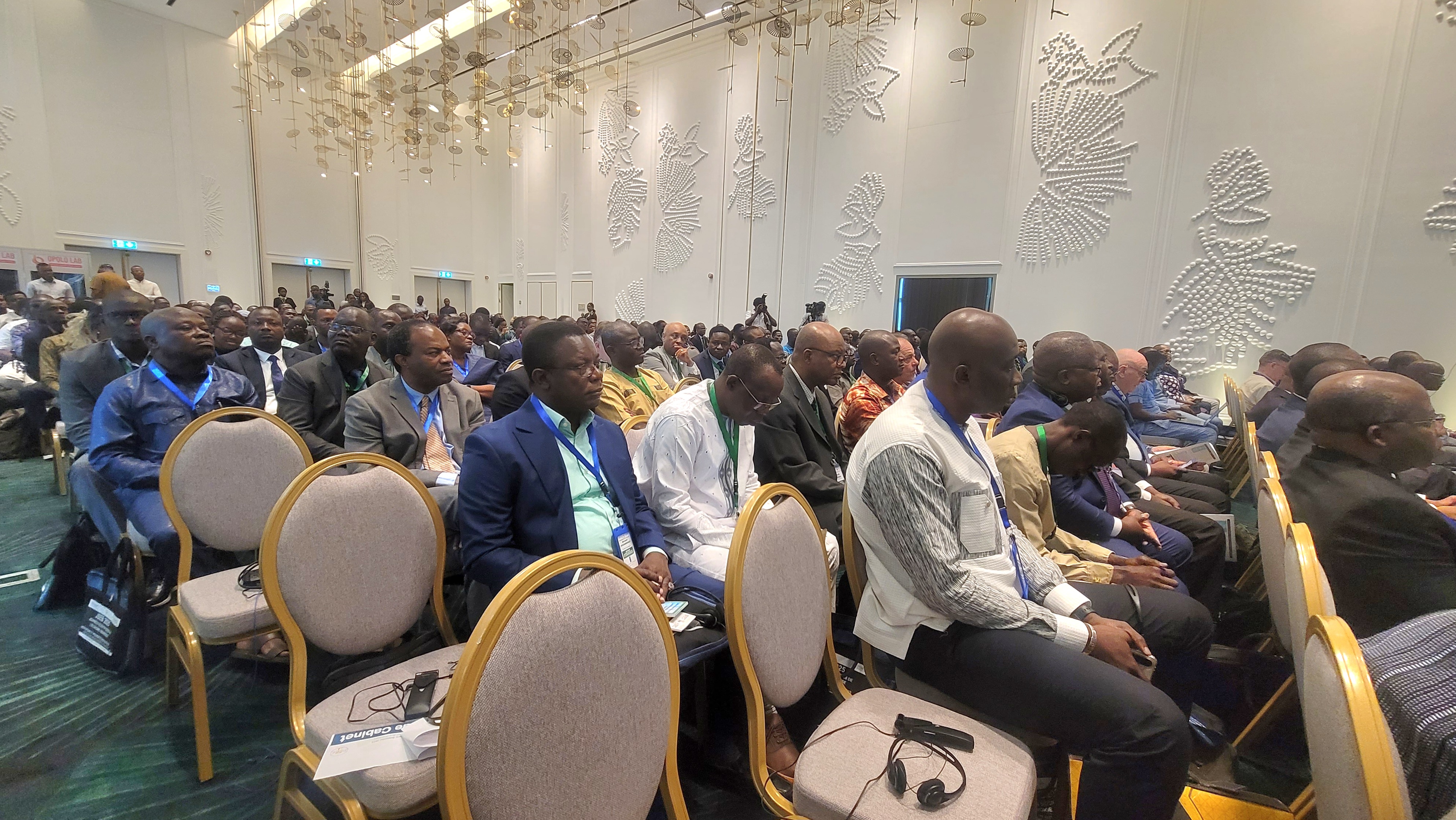
Représentant le ministre de l'Enseignement supérieur et de la Recherche scientifique, Josué Azandégbé a insisté sur la pertinence du thème pour un Bénin engagé, depuis 2016, dans d'importantes réformes institutionnelles et économiques. Il estime que l'administration béninoise est devenue plus cohérente et plus efficace sous les deux mandats du président Patrice Talon. À l'en croire, « la transformation du Bénin montre que le Bénin a fait le choix de la voie institutionnelle, celle que la théorie économique contemporaine identifie comme le fondement de toute prospérité ». Il souhaite que les travaux de ces journées permettent l'élaboration de politiques publiques plus efficaces.
Procédant au lancement officiel des JSEB, le directeur de Cabinet du ministre de l'Économie et des Finances, Hermann Orou Takou a mis en avant les réformes engagées pour moderniser la gouvernance économique, renforcer l'État de droit, digitaliser les services publics et restaurer la confiance des citoyens. « La transformation de notre système de gestion des finances publiques, la digitalisation progressive des services de l'État, l'autonomisation des organes de contrôle, la réforme de la justice économique, la mise en place d'agences spécialisées performantes traduisent cette volonté de faire des institutions, un vrai levier de développement », a-t-il déclaré.
Hermann Orou Takou reconnaît tout de même que certains défis doivent être relevés. « Je reste convaincu que ces journées permettront d'éclairer et d'orienter convenablement des actions et politiques publiques de développement d'une part et d'autre part de formuler des recommandations qui contribueront à faire des institutions de notre pays, un moteur incontournable de développement durable et de prospérité partagée », a-t-il conclu.

Invité spécial de cette édition, le professeur James Robinson, prix Nobel d'Économie 2024, a assuré la conférence inaugurale intitulée « Africa in World History ». Sa présence marque l'ambition internationale des JSEB et renforce la crédibilité scientifique du rendez-vous. Cette 6e édition permettra de réfléchir sur les défis institutionnels du Bénin et d'échanger sur les questions fondamentales liées à la gouvernance et aux institutions.
Akpédjé Ayosso
Le comité scientifique a reçu environ une certaine d'articles et 42 articles ont été retenus à l'issue d'un processus rigoureux de sélection. Ils feront l'objet de présentation au cours des deux jours. Le meilleur article présenté aux JSEB recevra une double distinction : un trophée et une attestation, tous deux portant la mention « Lauréat du meilleur article présenté aux JSEB 2025 ». Les articles qui se démarqueront par leur qualité feront l'objet d'une publication dans une revue scientifique internationale.
Categories: Afrique, Határon túli magyar portálok összesített hírei
Nicht nur in Aarauer Café: Auch an diesen Orten sind Kinder unerwünscht
Das Kinder-Verbot in einem Aargauer Café hat für mächtig Wirbel gesorgt. Dabei ist es nicht das erste Mal, dass Kinder nicht willkommen sind.
Categories: Afrique, Swiss News
Olympia-Traum wohl geplatzt: Schweizer Snowboarder verletzt sich bei Sturz am Rücken
Der Saisonstart findet ohne Nicolas Huber statt. Bei einem Sturz in der Qualifikation hat sich der Snowboarder schwer verletzt.
Categories: Afrique, Swiss News
Im Hockey und Fussball: Servette-Boss Fischer tritt ab
Didier Fischer hört als Präsident der Genfer Sportstiftung 1890 auf. Der Nachfolger steht schon fest.
Categories: Afrique, Swiss News
Es braucht 3,5 Millionen: Walliser Skigebiet kämpft ums Überleben – Bevölkerung eilt zur Hilfe
Der Sessellift braucht eine neue Steuerung, die Beschneiungsanlage eine neue Pumpstation. Das Oberwalliser Skigebiet Giw will langfristig überleben. Es muss deshalb jetzt investieren. Am Mittwochabend baten die Chefs die Bevölkerung um Unterstützung.
Categories: Afrique, Swiss News
Pages
the old site is here



© 2012-2015 Europa Varietas Foundation © 2015-2020 Europa Varietas Association
www.europavarietas.org | info(@)europavarietas(dot)org | Switzerland
This is a GDPR ready site




We are looking for sponsors for the English translation of these books, please contact turkeandras(at)gmail(dot)com